
The system of young stallion licensing, which has been in place for decades, has had its day. Following the publication in 2020 of the ‘Guidelines on Animal Welfare in Equestrian Sport’ – which have been implemented in Schleswig-Holstein since 2021, with the first amendments already in place – the German licensing system is undergoing reform. Last year, for example, stallions born in July were not admitted to the autumn licensing. The Holsteiner Breeders’ Association has responded by moving the young stallion licensing to February. To facilitate dialogue amongst all stakeholders, the Holsteiner Association organised a practical workshop on preparing young stallions for licensing.
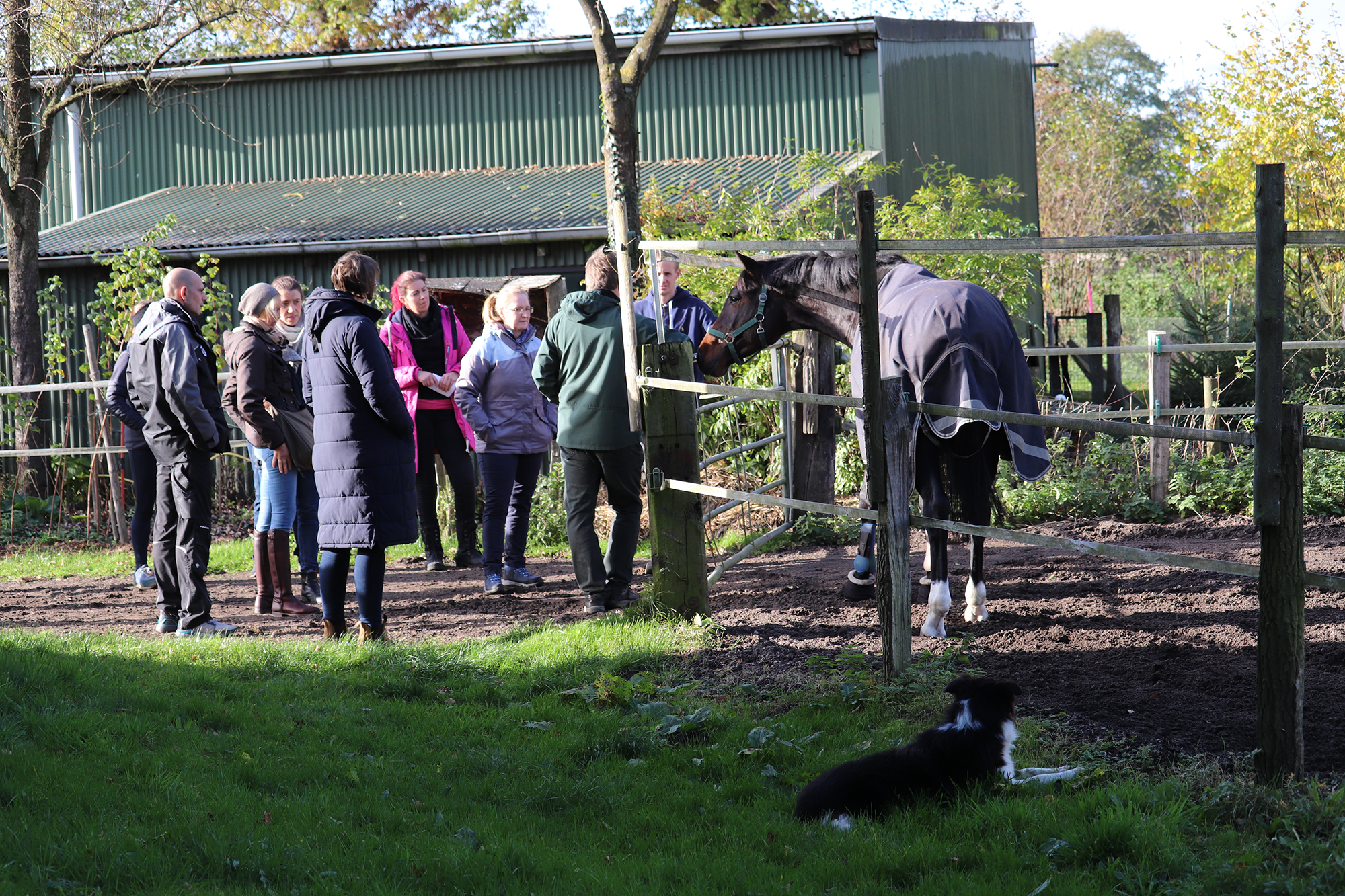
Around 30 representatives from the Association, the political sphere, district veterinary offices and young stallion training stables from Schleswig-Holstein gathered at the Horns family’s farm in Bredenbekshorst. “It is very important to us to work with the relevant officials to ensure the practical implementation of the guidelines,” said breeding director Stephan Haarhoff. “The focus is on giving the official vets, in particular, a better understanding of the day-to-day reality of young stallion training, so that we can find common ground.”
Step by step
How are young stallion candidates actually prepared for licensing? Stephan Haarhoff, along with Marc Horns and his partner Pia Peters, answered this question during the practical session. Horns currently has four stallions in preparation for the pre-selection at the end of November. Using two of them, he demonstrated the training programme leading up to licensing. He began with a son of Zuccero out of a Cash and Carry dam. Pia Peters explained how the young horses are introduced to their first tasks: “When they arrive, the stallions are still completely untrained; most of the time, they’re only used to being led by a halter. We then get them used to moving freely whilst wearing a halter – first throughout the whole arena and then in a separate section.” Once they have completed this calmly and composedly, lunging on the halter is introduced, later with a bridle and the halter fastened over it, and subsequently using the bridle alone. “It takes about four weeks before we use a girth for the first time,” Peters continued. “For some it goes faster, for others it takes longer. It’s important to let the horses set the pace.” Despite the unusually large crowd, the Zuccero son already appeared composed and experienced. He is already familiar with the next stage of his training: the attachment of the triangle reins. Two to three times a week, the stallions first warm up at a walk in the horse walker and are then allowed to run freely, or are lunged first without and then with triangle reins. A training session usually lasts about 20 minutes. With the second stallion by Keaton-Casalito, Horns demonstrated how he gets the horses used to free jumping. After warming up at a walk and running freely, the stallions are first introduced to poles on the ground, then to cavaletti, and finally to jumping a line. “Some horses quickly find their own way; others need more frequent repetition, so we wait longer before moving on to the next step,” reports Marc Horns. Free jumping is practised once a week. Every day, the young stallions are taken out to a paddock, regardless of the training schedule.
Standardisation not automatically beneficial for animal welfare
There was considerable interest in the insights provided by Marc Horns and his family, particularly from the official veterinarians, leading to a lively exchange of views. Among other things, the discussion centred on the extent to which a standardised training programme for young stallions would be feasible and sensible. For the official representatives, the focus was on standards designed to guarantee animal welfare throughout the entire training period, which must also be verifiable. Stephan Haarhoff referred to the training diaries introduced last year, which stallion trainers are required to complete for their charges in the run-up to the licensing event. Dr Thomas Nissen, animal welfare officer for the Holsteiner Verband, added that standardised training programmes are only of limited benefit to animals with “individual personalities, strengths and weaknesses” when it comes to ensuring animal-friendly training. “If the training is carried out properly, the horses will not be overburdened,” Nissen is certain. “It is the responsibility of the licensing committee to identify which stallions are suitable as sires on the basis of their natural disposition – and not on the basis of their preparation.” Dr Kristina Hein, Head of Department in the Dithmarschen district, argued: “We agree on how important it is to select the best stallions for breeding progress. And it is a good thing that we are discussing this in advance. But I expect the association to take a clear stance on how standards applicable to all parties involved can be developed in line with the guidelines,” said the vet. “This is a process that cannot be completed within two months. We must strike the right balance between the current legal situation and economic interests.” Those present agreed that regular and, where possible, unbureaucratic dialogue – perhaps in the form of a working group – would be beneficial for future cooperation. Breeding manager Stephan Haarhoff thanked the Horns family for organising the practical training day and summed up: “The practical training day was an all-round success. The lively exchange with the relevant authorities has shown that there can certainly be differing interpretations and views on the training of young stallions. In future, too, the Breeding Association must engage intensively with the content of the guidelines. In this process, it is essential to take into account the experience of our training centres in order to pursue an approach that is animal-friendly and practice-oriented.”
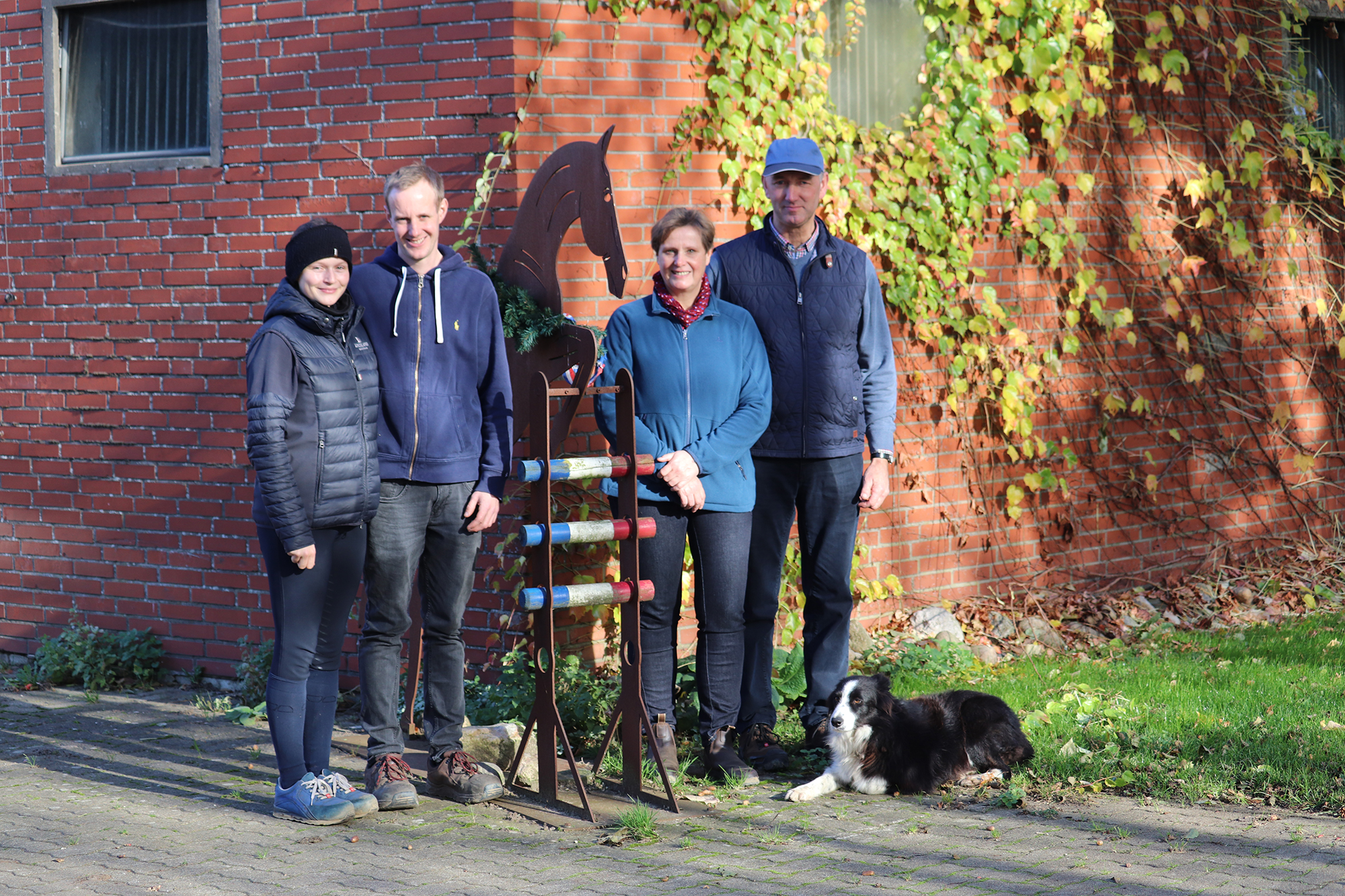
The Holsteiner Verband would like to extend its warmest thanks to Pia Peters, Marc Horns, Ute and Thomas Horns (from left) for their hospitality!


