
Holstein mares – it is not without reason that they are regarded and valued as the foundation of success, both literally and figuratively. In Holstein, mare lines are of particular importance. The allocation of a line number to each family is a system with a long tradition that remains in use to this day. Many other breeding associations envy the Holsteiner Horse Breeders’ Association (Verband der Züchter des Holsteiner Pferdes e.V.) for this system.
The first horse breeding associations had existed in Holstein as early as 1830 – but at that time they lacked clear objectives, structure and overarching leadership. It was not until 50 years later, with the founding of the Kremper Marsch Horse Breeding Association (1883) and others that followed, that Holstein breeders began to take their destiny into their own hands. The driving force behind this development was Georg Ahsbahs, who, with his records on the pedigree and history of horse breeding in Holstein, laid the foundations for the further development of today’s Holsteiner Verband.
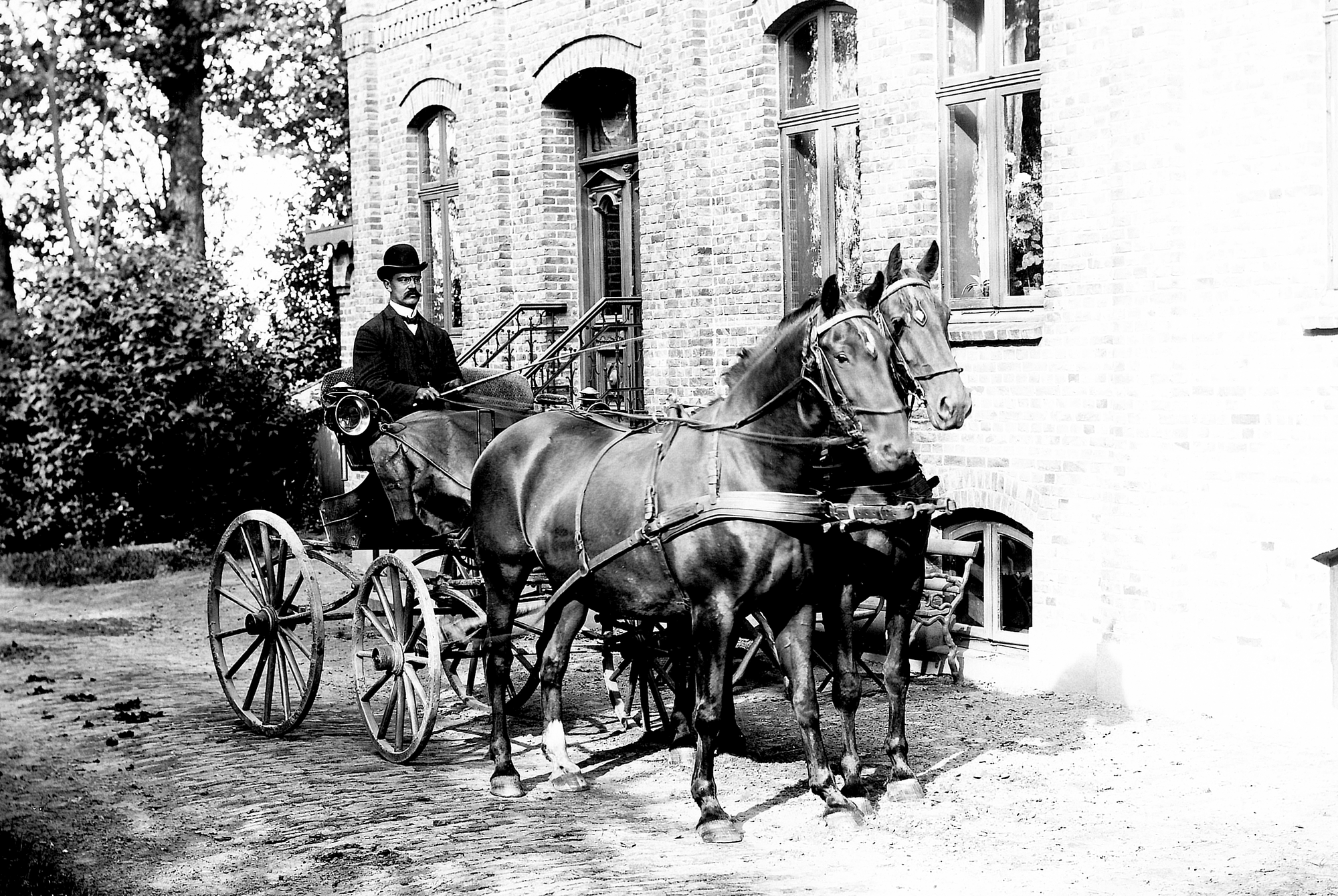
Georg Ahsbahs with his pair of horses, circa 1900
Focus
on quality
The main task of the horse breeding association in the Kremper Marsch was to maintain a mare pedigree register. This was because fierce competition and the general economic climate forced farmers to focus more than ever on ensuring the highest quality of their products. Consequently, the stud books served not only to ensure and improve the quality of breeding stock, but also to offer buyers greater guarantees. The stud book for the Holsteiner Marsch horse became a model for German horse breeding, as records had never before been kept on such a scale.
Ancestry Registers and Pedigrees
Later, all registered mares were recorded in the stud books. In addition to the mare pedigree register, these contained comprehensive reports on horse breeding, geographical conditions and much more. From the third volume of the stud book onwards, chapters containing pedigree registers and pedigree charts for the mares were also included. The pedigree register thus served as proof of bloodline, whilst the pedigree table served as proof of quality – another innovation, as other stud books (e.g. in thoroughbred breeding) only recorded proof of bloodline.
776, 741 and 104A with the most representatives
The third stud book volume listed 1,076 lines; by the 2000s, around 8,900 lines had been established, although many of these had disappeared due to dwindling numbers even in the 1950s and 1960s. Today, the actively registered broodmares can be assigned to around 420 lines. Most mares belong to lines 776, 741 and 104A.
This special significance of the mare lines and their registration is something that has always made the Holstein population something quite special, and continues to do so today. Breeding director Stephan Haarhoff shares this view: “For our breeders, the mare lines are of enormous importance and great value: they know their lines very well and have therefore always been able to make targeted mating decisions, which continues to contribute significantly to the success of the population to this day.”
The #holsteinerheldinnen series is dedicated to our Holsteiner mares. Here you can find out interesting facts about the history, Holsteiner mare lines and the latest developments regarding mare registration, the awarding of premiums and much more.
Cover photo: Janne Bugtrup, article photo: Holsteiner Verband Archive


